
When deciding whether to rent or buy a vacuum packaging machine, consider your production volume, available working capital, and expected period of use. Renting avoids the full upfront purchase cost and includes servicing, making it suitable for short-term or seasonal production needs. Purchasing lowers long-term unit packaging costs when a machine is used consistently across extended multi-year production runs.
Commercial food processors, abattoirs, caterers, and retail butcher shops across Australia need to weigh machinery costs against their specific production requirements. To protect working capital, you need a clear understanding of daily packaging volumes, ongoing maintenance needs, and realistic cash flow forecasts.
With more than 20 years of trade-qualified engineering expertise, we support food businesses with machinery sales, flexible rental arrangements and full workshop support. Contact our team to discuss the right vacuum packaging option for your business.
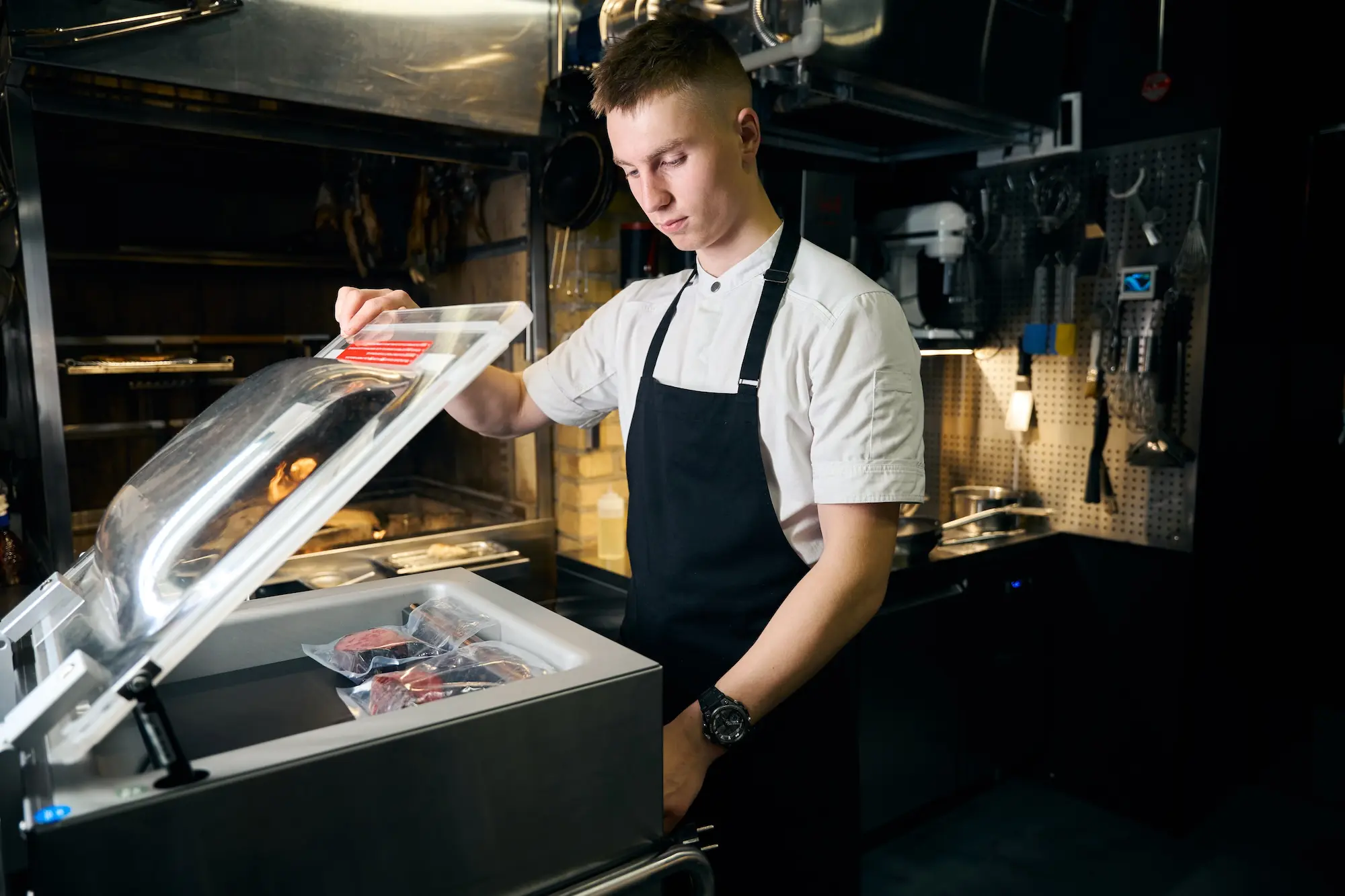
Rent or buy a vacuum packaging machine: key factors to compare
Whether you need a commercial vacuum sealer for one kitchen or a full production line, the decision balances short-term capital preservation against long-term packaging costs. When evaluating your options, consider the following key financial and operational factors:
- Renting preserves cash flow by avoiding initial capital expenditure.
- VACPAC rental packages include servicing and maintenance, with the exact machine, rental term, and other support arrangements confirmed before hire.
- Outright purchase lowers long-term unit packaging costs for stable, high-volume production lines.
- Quality used equipment offers an intermediate entry point with reduced initial investment.
- Australian Government guidance on leasing or buying business equipment highlights the trade-off between spreading equipment costs over time and potentially saving money by purchasing outright, making total cost and cash flow important factors in the decision.
Financial mechanics of vacuum packaging machine rental in Australia
Renting a vacuum packaging machine in Australia gives your business access to commercial sealing equipment without the full upfront purchase cost. The financial advantages depend on the contract term, monthly payments, maintenance inclusions, and conditions for returning or upgrading equipment.
We offer short- and long-term rental options to suit different production requirements. Rental packages include servicing and maintenance, with the specific machine, rental term and other support arrangements confirmed before hire. You can rent a vacuum packaging machine to match a temporary production need.
Capital expenditure (CapEx) vs operational expenditure (OpEx)
Buying commercial machinery involves capital expenditure (CapEx), with the equipment recorded as an asset on your balance sheet and accounted for under applicable depreciation rules. Ownership also places long-term maintenance and repair responsibilities directly on your business outside of standard warranty terms.
Rental structures convert machinery acquisition into predictable operational expenditure (OpEx) with included service coverage, helping preserve working capital for inventory, staffing and expansion. The tax treatment of vacuum packaging machine rental payments depends on the agreement and your business’s circumstances. Ask your accountant or registered tax adviser to confirm the applicable treatment before making a rental or purchase decision.
Short-term seasonal hire vs long-term machinery ownership
Seasonal volume surges, such as Christmas meat processing or short-term catering contracts, benefit from flexible rental terms without long-term debt commitments. Renting grants immediate access to supplementary sealing capacity without committing to a permanent equipment purchase.
For permanent, high-volume production lines, buying outright lowers the total cost per package over multi-year production runs. The financial outcome depends on purchase price, financing rates, routine maintenance, machine utilisation and eventual equipment resale value.
If you are scaling up temporarily or testing new product formats, you can rent a vacuum packaging machine before committing to capital outlay.
Production assessment steps before selecting machinery financing
Before signing a rental agreement or purchase contract, audit your facility layout, batch targets and daily cycle requirements. The optimal equipment strategy balances present production volume with realistic growth projections.

Auditing chamber capacity and vacuum pump cycle requirements
Your daily tray or pouch count determines the chamber size, pump capacity and cycle times you need. Pump capacity matched to the required vacuum depth supports consistent sealing and avoids a machine that is undersized for your shift demands.
Measure your largest product dimensions to ensure correct seal bar lengths and chamber depths. The choice between a benchtop sealer, double chamber unit or high-volume thermoformer also depends on floor space, operator workflow and product packaging formats.
Evaluating cash flow forecasts and working capital reserves
A cash flow forecast shows whether preserving capital outweighs long-term purchase savings. Growing businesses frequently need accessible working capital for raw materials, labour, compliance and unexpected operating expenses.
Before committing to a purchase, food businesses should forecast how upfront payments, loan instalments or monthly rental fees will affect working capital, following the Australian Government advice on equipment costs and business cash flow.
Compare suitable models, including Henkelman vacuum packaging machines, against your product specifications, output targets and available budget before committing to a financing path.

Comparing the total vacuum packaging machine cost in Australia
To compare the total cost of renting and buying, calculate the costs over the same period and for a machine that meets the same production requirements. Include the purchase price or rental payments, servicing, replacement wear parts, financing costs, expected downtime and potential resale value. For rental agreements, check which maintenance and support services are included before comparing the total commitment.
The most suitable option depends on how frequently the machine will be used, the length of time it is needed, available working capital and the cost of maintaining production. Request a written quotation for the relevant machine and rental term to make a like-for-like comparison.
| Financial factor | Short-term rental | Long-term rental | Outright purchase (new) | Refurbished purchase |
|---|---|---|---|---|
| Initial outlay | No full purchase price; confirm any upfront charges | No full purchase price; confirm any upfront charges | High (full purchase price) | Moderate (reduced price) |
| Ongoing payment | Regular rental payments | Regular rental payments | Zero (or loan repayment) | Zero (or loan repayment) |
| Maintenance | Servicing and maintenance included | Servicing and maintenance included | Warranty only (1–2 years) | Limited warranty |
| Asset ownership | Supplier retains ownership during rental | Supplier retains ownership during rental | Client business | Client business |
| Flexibility | Subject to agreed rental terms | Upgrade or downgrade options available; confirm arrangements | Low (requires resale) | Low (requires resale) |
Total cost of ownership: Maintenance, wear parts and downtime protection
Initial acquisition pricing represents only a portion of total operational expenditure. Vacuum pump oil changes, sealing wire, Teflon tape, silicone counter-pressure strips and lid gaskets require periodic replacement based on machine workload and maintenance schedules.
Machinery failure disrupts factory throughput, delays deliveries and risks expensive product spoilage. VACPAC may provide loan equipment while machinery is being repaired or rebuilt in our workshop, or while a specific part is being sourced, subject to availability and suitability. Confirm the availability of a suitable machine and the applicable support arrangements with our team. See our vacuum packaging servicing and support.
Sanitation compliance and electrical testing standards
Vacuum packaging equipment used in food handling should be easy to clean and sanitise, and suited to the washdown and safety protocols of commercial kitchens, processing facilities and abattoirs.
Electrical safety testing (AS/NZS 3760) and washdown requirements
Stainless steel construction and smooth surfaces facilitate thorough sanitation, but washdown ratings depend on ingress protection (IP) ratings and component isolation. Always check manufacturer instructions before exposing machinery to high-pressure washdown, heat or caustic cleaning chemicals.
In Queensland, testing and tagging requirements depend on the type of electrical equipment and work environment under the Electrical Safety Regulation. AS/NZS 3760 provides additional guidance for in-service inspection and testing.
For facilities operating in Queensland, refer directly to official WorkSafe Queensland guidance on testing and tagging electrical equipment to confirm site-specific requirements for both owned and hired machinery.
Matching acquisition models to your food operations
Different food businesses operate on distinct shift patterns, production volumes and cash flow cycles. Your machinery acquisition approach should align with daily throughput demands and risk tolerance.
Seasonal meat processors and boutique caterers
Meat processors experiencing short-term volume surges during peak trade periods (such as Christmas or Easter) can use short-term rentals to absorb production spikes without tying up annual capital in idle plant machinery.
Boutique caterers and food brand startups testing new commercial lines benefit from hiring machinery to validate market demand prior to purchase. Confirm included servicing and workshop support before peak cycles to help protect packaging output.
Industrial packaging facilities and Brisbane food manufacturers
Facilities operating multi-shift continuous production lines generally justify capital investment in heavy-duty double chamber machinery or automated thermoforming plant. Direct ownership gives you full control over machine customisation, conveyor integrations and automated discharge systems.
For regional facilities and commercial operators, sourcing an industrial unit with localised access to vacuum packaging servicing and support reduces long-term operational risk.
Businesses looking to minimise initial capital expenditure while retaining asset ownership can also evaluate quality used vacuum packaging equipment. Review equipment refurbishing history, technician inspection logs and warranty terms prior to purchasing.
Selecting the optimal equipment strategy for your facility
Choosing whether to rent or buy a commercial vacuum packaging machine comes down to aligning production goals with working capital strategy. Renting offers cash flow flexibility and includes maintenance support for seasonal or growing businesses, whereas purchasing generally delivers a lower cost per cycle over long-term, high-volume manufacturing runs.
Calculate the total cost of ownership, including servicing, wear parts, financing and loan machine availability, before finalising your decision. A machine specified for your floor layout and daily cycle demands supports long-term operational reliability.
Contact our trade-qualified engineering team on 07 3806 5972 or email [email protected] to request a tailored machinery comparison and written quotation. For urgent after-hours support, call 0402 749 839. You can also discuss the right vacuum packaging option for your business directly with our specialists.
Frequently asked questions
Is it cheaper to rent or buy a vacuum packaging machine?
Renting is more cost-effective for short-term needs, seasonal volume spikes or businesses conserving working capital, as servicing is included. Buying reduces the cost per packaging cycle over multiple years once you amortise the initial capital outlay across continuous daily production runs.
Can Australian businesses rent a vacuum sealer short-term?
Yes. Australian food businesses can secure short- and long-term rental agreements through VACPAC. Flexible hire options accommodate seasonal demand surges, boutique production runs or emergency equipment replacement without requiring long-term capital commitments.
Does machine rental include routine servicing and breakdown repairs?
VACPAC rental packages include servicing and maintenance. Confirm the specific coverage for breakdown repairs, replacement parts and loan equipment before signing the rental agreement, as these arrangements may depend on the agreed terms.
Is used vacuum packaging equipment worth buying?
Workshop-refurbished vacuum packaging machinery can provide an economical alternative to new equipment. Review its condition, service history, availability of replacement parts and expected maintenance costs before purchasing.
Are machinery rental payments tax-deductible for Australian companies?
The tax treatment of vacuum packaging machine rental payments depends on the agreement and your business’s circumstances. Ask your accountant or registered tax adviser to confirm the applicable treatment before making a rental or purchase decision.
What happens if a rented machine breaks down during production?
We provide service support during equipment breakdowns. We may provide loan equipment while a machine is being repaired or rebuilt, or while a specific part is being sourced, subject to availability and suitability. Contact our team to confirm the support arrangements and whether a suitable loan machine is available.